
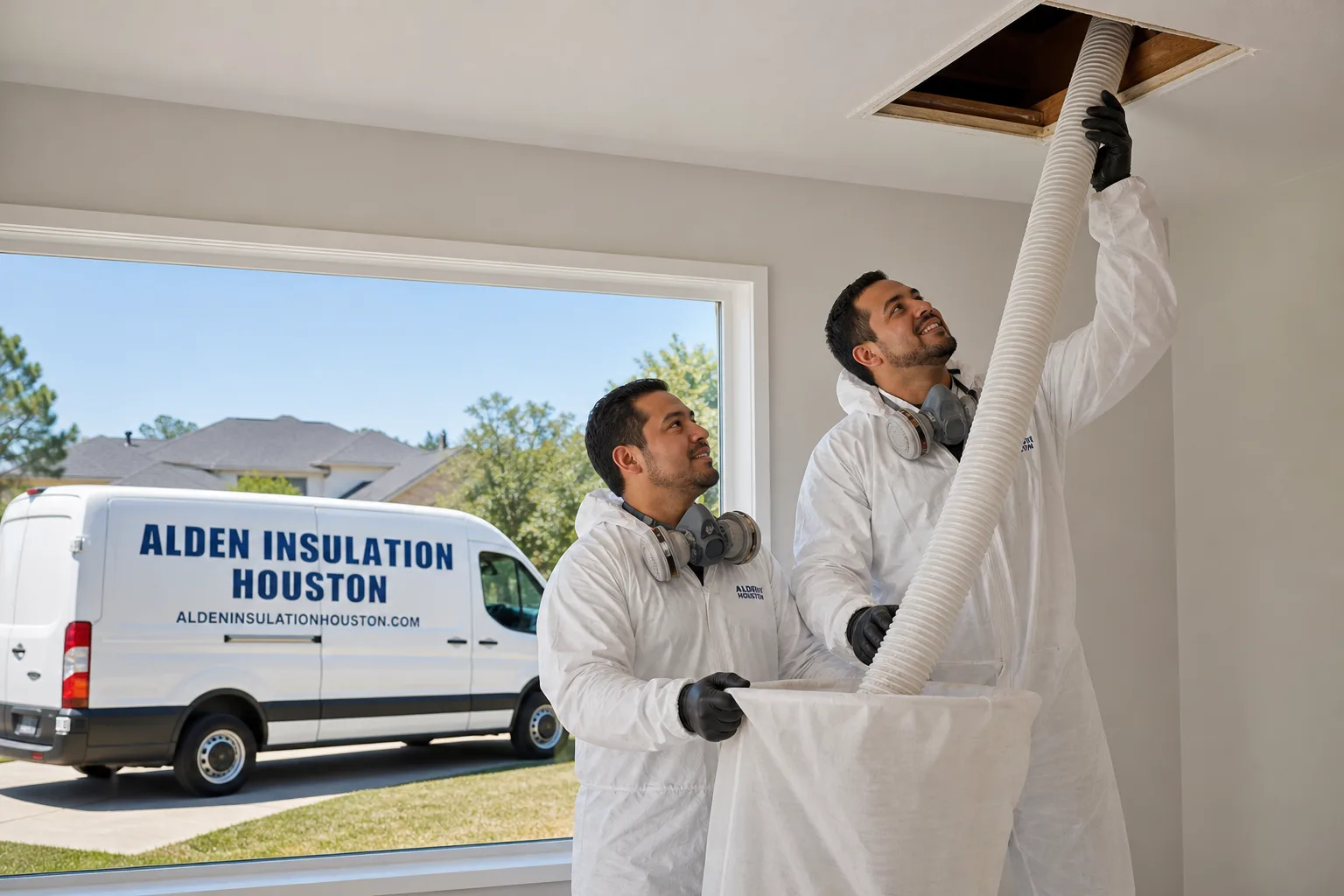
How Much Does Home Energy Audit Cost in Houston?
A home energy audit in Houston typically costs between $250 and $650 for a professional, whole-home assessment in 2026. Basic walkthrough audits from utility companies or quick visual inspections can run as low as $100, while comprehensive audits with blower-door testing and infrared thermal imaging land in the $400 to $650 range. The price depends on home size, the depth of testing involved, and the equipment the auditor brings to the job. Most Houston homeowners who get a full audit report it as the single most useful diagnostic they have run on their house, because it tells you exactly where your cooling dollars are leaking out between May and October.
If you’re researching this as part of a larger insulation or attic repair project, the good news is straightforward: many Houston insulation contractors, including Alden Insulation Houston, offer energy audits as a bundled service when you are already addressing attic insulation, air sealing, or blown-in insulation. That changes the math considerably. The full page on Home Energy Audit in Houston walks through what an audit covers step by step, but here we’ll focus on the dollars.
Home Energy Audit Cost Breakdown (2026)
The table below reflects what homeowners in the Houston metro area should expect to pay in 2026, based on audit type. Houston’s market differs from northern cities in one key way: auditors here focus heavily on cooling load, duct leakage in unconditioned attics, and moisture intrusion, because those are the forces that punish utility bills in a Gulf Coast climate.
| Audit Type | What You Get | Typical Houston Price Range |
|---|---|---|
| Visual walkthrough (utility-sponsored) | Basic inspection, no diagnostic equipment, checklist-style report | $100 – $200 (often subsidized or free through utility programs) |
| Standard professional audit | Blower-door test, combustion safety check, moisture assessment, written report | $300 – $450 |
| Comprehensive audit with thermal imaging | Blower door, infrared camera scan of walls/ceilings/ducts, room-by-room airflow measurements, full remediation roadmap | $450 – $650 |
| Audit bundled with insulation work | Full diagnostic assessment performed before air sealing or insulation install, often credited toward project cost | $0 – $250 (varies by contractor) |
What moves the price within those ranges comes down to three things: square footage, the age of the home, and how much equipment the auditor unpacks. A 1,200-square-foot ranch built in 1990 costs less to audit than a 3,800-square-foot two-story built in 1978 with two air handlers and original ductwork. The larger home requires more blower-door test cycles, more room pressure measurements, and significantly more time interpreting infrared images across cathedral ceilings, knee walls, and unconditioned attic spaces. The older home usually means the auditor finds more: failed weatherstripping at the attic scuttle hole, disconnected duct collars, bath fans venting directly into the attic, and R-value that has settled far below what the original builder installed. That detail can actually save a homeowner money in the long run, because the audit locates problems in priority order.
Houston’s utility providers have also run audit rebate and subsidy programs in the past through CenterPoint Energy and municipal partners. Availability changes year to year and is tied to energy-efficiency initiative funding. It is worth checking with your provider before you pay the full retail price, because some Houston homeowners have gotten standard professional audits for under $100 through these programs. If you want a number to compare against, the unsubsidized market rate for a professionally performed audit with a blower door in Houston is roughly $350 to $500.
What Affects Home Energy Audit Pricing in Houston
Several factors specific to the Houston housing stock and climate move the final audit price. Here is what an auditor considers when quoting a job in this market:
- Home square footage and number of zones. A home over 3,000 square feet with two HVAC systems requires more testing time per system. Each zone needs its own pressure testing sequence, which adds labor hours to the audit.
- Age and construction era. Homes built before Houston adopted stricter energy codes in the early 2000s tend to have leakier envelopes and more duct problems. They take longer to assess properly, but they also produce larger utility savings once the remediation is done.
- Attic accessibility and depth. Low-slope roofs, cramped attic hatches, and blown-in insulation that has drifted into every corner make access harder. In neighborhoods like Meyerland or Sharpstown, where homes were built decades ago and attic access is often through a narrow hallway closet, the auditor simply needs more time.
- Duct leakage testing. This is the most climate-critical test for Houston homes, where ducts run through unconditioned attic spaces that hit 130°F in July. Adding a duct pressurization test to the audit typically adds $75 to $150 to the total.
- Infrared thermal imaging. Not every auditor includes IR scanning in a base-price audit. The best ones do, because Houston’s heat and humidity create condensation patterns that only show up through an IR lens. Expect the camera work to be a line item or a firm reason to choose one auditor over another at the same price.
- Moisture and mold assessment. Houston’s humidity creates attic moisture problems that auditors in dry climates rarely deal with. A proper Houston audit includes checking soffit vent performance, looking for rust on hvac duct straps, and measuring relative humidity in the attic cavity. This is built into the price of a good audit, but it’s not universal in cheap walkthroughs.
One extra cost factor is whether the audit includes combustion safety testing on gas appliances. Natural gas is common in Houston, especially in older neighborhoods like Garden Oaks and Oak Forest, where many homes still have atmospheric-vented furnaces and water heaters. A backdraft test and carbon monoxide check should be part of any professional audit, and if the auditor says it isn’t necessary, that’s a reason to look elsewhere.
How to Save on Home Energy Audit
The most direct way to reduce your audit cost in Houston is to combine it with insulation work you are already planning. Alden Insulation Houston provides a written price before any work begins, and when an attic insulation or air sealing project includes an energy audit as part of the scope, the audit cost is folded into the job rather than billed separately. That means you end up paying for the insulation and getting the diagnostic information as part of the process.
Before you schedule anything, check whether your utility provider has a rebate or subsidy program running in 2026. The availability of these programs changes year to year, but when they are funded, they represent the single largest discount available. Call your electric provider and ask directly about home energy audit rebates for single-family Houston residences. Many providers do not advertise these programs prominently.
Also, be clear with the auditor about what you actually need. If you are trying to solve one specific problem, like a bedroom that stays ten degrees warmer than the rest of the house, you might not need a full whole-home audit. A targeted room pressure test and duct leakage check can run under $300. But if you are trying to make the entire house perform better in August, the full audit is the better investment because it identifies all the compounding problems at once. A partial audit that misses a disconnected duct run can send you down the wrong remediation path entirely.
For a free estimate on audit and insulation work together, call Alden Insulation Houston at (806) 581-1010. The estimate is free, the price you approve is the price on the invoice, and the audit findings are written down in language you can read.
What Does an Energy Audit Actually Find in Houston Homes?
This is where the audit pays for itself. In Houston, the problems are remarkably consistent from house to house, and an experienced auditor has seen them all hundreds of times. The most common findings in Houston homes include:
- Attic insulation below R-38. Houston is in climate zone 2A, which means the recommended minimum attic insulation is R-38, or about 13 to 14 inches of blown fiberglass. Many older Houston homes have settled insulation sitting at R-19 or less, which is less than half of what the climate demands. An audit measures the actual depth and calculates a current R-value, then tells you exactly what you need to bring it up.
- Air leakage at the attic floor. Every penetration in the ceiling plane, from recessed lights to ceiling fans to HVAC registers, lets conditioned air escape into a 130-degree attic. The blower-door test measures total leakage in CFM50, and the infrared camera shows precisely where the leaks are. In Houston, attic-floor air leakage typically accounts for 15 to 30 percent of a home’s total cooling load.
- Duct leakage in unconditioned attics. The Department of Energy has published data showing that typical duct systems lose 20 to 30 percent of the air moving through them to leaks, and in Houston that leaked air is going into the hottest part of the house. A duct pressurization test during the audit quantifies this loss. Fixing duct leaks is often the single highest-ROI repair in a Houston home.
- Bathroom fans venting into the attic. This is so common in Houston that auditors barely need the camera to find it. Every bath fan that dumps warm, humid air into the attic space adds moisture load to a cavity that already struggles to stay dry. The fix is straightforward but requires proper vent pipe installation through the roof or soffit.
- Inadequate soffit and ridge ventilation. Houston attics need continuous intake ventilation at the soffits and adequate exhaust at the ridge. When soffits are blocked by blown insulation, which is common when insulation was installed without proper baffles, the attic can’t breathe and becomes a humidity trap.
Every one of these findings ties back to two things: cooler air escaping into the attic and warmer, wetter attic air working its way into the living space. A good audit doesn’t just list the problems, it ranks them so you know which repairs will deliver the most comfort and bill reduction per dollar spent. That ranked list is the part of the report that matters most to a Houston homeowner planning repairs in stages.
Why Audit Prices in Houston Differ From Other Texas Cities
Houston audit pricing runs slightly higher than the Texas statewide average, and there is a physical reason for it. The Gulf Coast humidity creates a moisture-related workload that doesn’t exist in Dallas, Austin, or San Antonio to the same degree. A competent Houston auditor has to spend real time on moisture assessment, condensation mapping, and duct-leak testing because those are the conditions that drive Houston energy bills and comfort complaints.
This is also why some national franchise audit prices, which are set around national averages, can miss the mark in Houston. A franchise auditor pricing a Houston job the same as a Phoenix job is not accounting for the humidity-related inspection work this market demands. Local auditors who work Houston attics year-round know that the moisture and duct issues are the first thing to check, not an afterthought. In neighborhoods from Katy to Clear Lake to The Woodlands, the same pattern repeats: too little attic insulation, leaking ducts, and soffit ventilation that has been blocked by years of accumulated dust and blown insulation drift.
The Houston housing stock adds another variable. Houston grew in dramatic spurts, which means a neighborhood of 1960s ranch homes sits next to a 1990s subdivision, which sits next to 2010s construction. Each era has its own typical problems and its own typical audit profile. A 1960s Sharpstown home often needs complete air sealing plus R-38 attic insulation. A 1990s Cinco Ranch home may be decent on insulation but terrible on duct leakage. A 2010s home in Sienna was probably built with code-level attic insulation but may still have builder-grade air sealing that an audit can tighten considerably. The auditor’s local knowledge is part of what you are paying for.
Items an Energy Audit Should Never Skip
If an audit in Houston costs $400 or more, there are certain items that should be included without question. Here is a checklist to use when calling auditors for quotes:
- Blower-door test. This is the foundation of any real audit. It depressurizes the home and measures total air leakage in a standardized, repeatable way. An audit without a blower door is a visual inspection wearing an audit’s name tag.
- Duct leakage test. In Houston, this is non-negotiable. If the auditor pushes back, find a different auditor.
- Infrared scan. Not every problem shows up in a pressure test, and the IR camera is what locates missing insulation, moisture intrusion, and thermal bridges inside wall and ceiling cavities.
- Combustion safety check. Any gas appliance in the home, including furnaces, water heaters, and stoves, should be tested for backdrafting and carbon monoxide. This has real safety implications, so do not skip it.
- Attic inspection with photos. The written report should include photographs of what the auditor found: settled insulation, disconnected ducts, bath fans venting into the attic. A report without photos means you are relying entirely on someone else’s notes.
All of these items are standard in the audits Alden Insulation Houston performs before insulation or air sealing work. The report is delivered in writing, the findings are explained in plain language, and the recommendations are ranked by return on investment.
Audit First, Insulation Second
There is a sequence to doing this right, and it is worth understanding before you schedule anything. An energy audit tells you what is wrong and where. Then the insulation or air sealing work fixes what the audit found. Doing the insulation without the audit can mean spending money on the wrong fix, or on the right fix applied to the wrong part of the house.
A common Houston example is a homeowner who adds R-38 blown-in insulation to an attic that has massive air leakage around the attic hatch and recessed lights. The insulation goes in on a Monday, and by Thursday the homeowner is back in the same hot room, because the new insulation can’t stop air that is moving through gaps in the ceiling plane. An audit performed first would have found that air leakage and ranked it above insulation as the first repair. That sequence single-handedly justifies the audit cost.
The same logic applies to ductwork. A homeowner who seals and insulates the attic without testing the ducts may have a half-fixed house. A duct system leaking 25 percent of the conditioned air it moves means that every dollar spent on attic insulation is insulating a house that is losing conditioned air out into the attic before it ever reaches the rooms. The audit finds the duct leaks first. The insulation work comes second. That is the proper order.
At Alden Insulation Houston, the audit and the insulation work proceed in this sequence as standard practice. The audit establishes what the house needs, the written estimate reflects that scope, and the insulation or air sealing work then addresses the problems in priority order. The 365-Day Done Right Promise applies to every repair and installation, which means if the work fails to perform as specified within a full year, we come back and make it right at no charge.
FAQs – Home Energy Audit Cost
How much does a home energy audit cost in Houston?
A professional home energy audit in Houston costs $250 to $650 in 2026, with most full-service audits landing between $350 and $500. Utility-subsidized visual audits can run as low as $100 or sometimes free, but they do not include blower-door testing or infrared imaging. For a full diagnostic audit with duct leakage testing, you should budget $400 to $650 depending on home size. Call (806) 581-1010 for a free estimate on an audit combined with insulation work.
Is a home energy audit worth the money?
For most Houston homeowners, yes. A $400 to $500 audit that finds a 25 percent duct leakage problem can point you to a repair that cuts your August cooling bill by a fifth or more, and Houston cooling bills run higher than the national average due to the long cooling season. The audit also tells you what not to spend money on, which is often worth as much as the findings themselves. Homeowners who skip the audit and guess at repairs frequently spend more than the audit would have cost and still don’t fix the real problem.
Can I do my own home energy audit?
You can do a basic walkthrough yourself using a checklist of common problems, and it costs nothing. But a proper audit requires a blower door, a duct pressure gauge, and an infrared camera, none of which are practical homeowner purchases. A professional audit also includes combustion safety testing on gas appliances, which has genuine safety implications. You can safely check things like visible attic insulation depth and weatherstripping condition yourself, but the diagnostic equipment and the trained interpretation of its readings are what separate a professional audit from a self-check.
How long does a home energy audit take?
A standard professional home energy audit in Houston takes 2 to 4 hours on site for a home under 2,500 square feet. Larger homes or homes with two HVAC systems typically run 4 to 6 hours. The blower-door test itself runs about 30 minutes including setup, the duct test another 30 to 45 minutes, and the infrared scan occupies the bulk of the remaining time. The written report usually follows within a few days.
Is it cheaper to get an energy audit through my utility company?
Yes, if your utility has an active program in 2026. Houston-area providers have offered subsidized audits at $50 to $150 in past program years, which undercuts the private market significantly. The tradeoff is that utility-sponsored audits may use checklists and visual inspections rather than full diagnostic equipment, so confirm what is included before booking. If full blower-door and duct testing is what you need, a private audit at $350 to $500 is the appropriate comparison point. Call (806) 581-1010 to ask about combining an audit with insulation and air sealing for a better overall price.
What should I do with the audit results?
Start with the audit’s ranked list of problems, which should be ordered by return on investment. The highest-impact items in Houston homes are almost always duct sealing, attic air sealing, and adding R-38 insulation. Get written estimates for each item, compare them against your budget, and proceed in order. Alden Insulation Houston provides written prices before work begins, so you can approve the exact scope and cost before a single tool comes off the truck.
How the Audit Connects to Insulation Work
Energy audits and attic insulation are two parts of one job, and the best results come when they are handled together. The audit measures what is leaking and where the losses are. The insulation work then fixes those losses with the right materials, installed at the correct depth and density, with the air sealing done first so the insulation actually works as rated.
Alden Insulation Houston installs blown-in insulation and attic insulation using products from Owens Corning, Johns Manville, Knauf, Rockwool, CertainTeed, and GreenFiber. We also perform insulation removal when existing attic insulation is contaminated, compressed, or holding moisture from a roof leak or a bath fan that vented into the attic for a decade. Whatever the audit finds, the fix is planned around the specific findings, not around a generic one-size-fits-all insulation package.
Every Alden job follows the same discipline: a written price before the work starts, a written 365-Day Done Right Promise on the completed project, and a background-checked, uniformed technician inside the scheduled appointment window. Calls are answered by a live person 24/7, not a voicemail system or an answering service. The Garrison Standard, which established Alden Attic Insulation’s operating baseline back in 2002, applies to every job at every location. Bryce Holloway, who leads the Houston operation, holds the crew to that standard on every attic we enter.
If you want to know what your Houston home is losing before you commit to a fix, start with the audit. If you want the audit and the fix handled by the same crew under one written guarantee, call (806) 581-1010 and ask for a free estimate. We will schedule a time, show up when we said we would, and give you the written number before any work starts.
Written by Bryce Holloway, Owner at Alden Insulation Houston, serving Houston and surrounding communities since 2002.
What Our Customers Say
"Removed rodent-damaged insulation, sanitized, and replaced it. Thorough and honest."
- Sue M."Spray foam in the rim joist. Floors above are warmer."
- Iris L."Blown-in insulation in the attic by a veteran crew. They air sealed the top plates first, installed baffles, and marked the depth with rulers. Bills dropped right away."
- Roy H.