
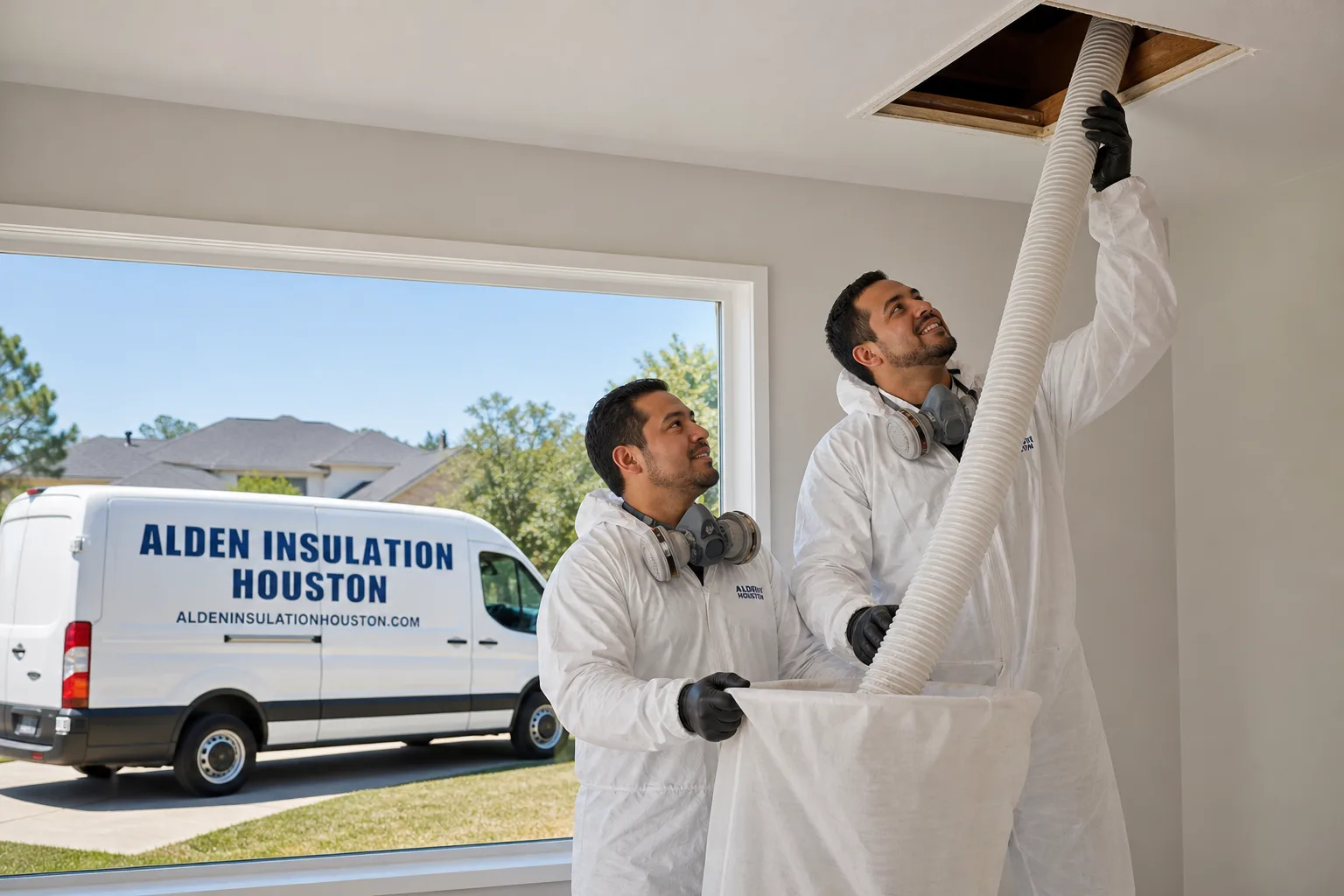
How Much Does Blown-In Insulation Cost in Houston?
Blown-in insulation in Houston typically costs $1,650 to $3,900 for a standard 1,500-square-foot attic, and most homeowners pay between $1.10 and $2.60 per square foot for materials and labor. Your exact price depends on the current R-value in your attic, access conditions, and whether you’re choosing fiberglass or cellulose. Alden Insulation Houston gives written pricing before any work starts, so the number you approve is the number on the invoice.
Key Takeaways:
- Typical total cost: $1,650 to $3,900 for an average Houston attic
- Most jobs run $1.10 to $2.60 per square foot, materials and labor included
- Cellulose runs slightly cheaper than blown fiberglass; both hit Houston’s recommended R-30 to R-38
- Older homes in the Heights or Montrose often need air sealing first, adding $400 to $900
- Every Alden job carries a written 365-day guarantee through the Done Right Promise
This guide breaks down real Houston pricing, what moves the number up or down, and how to avoid the low-quote-then-revise game that’s common in this trade. For a blown-in insulation project in Houston, the written quote should tell you everything up front.
Blown-In Insulation Cost Breakdown (2026)
Here’s what our Blown In Insulation services actually cost in the Houston market right now. These numbers reflect what we see on real jobs across Harris, Fort Bend, and Montgomery counties in 2026. They’re not national averages pulled from a database. They’re Houston numbers.
| Line Item | Typical Range (Houston, 2026) | Notes |
|---|---|---|
| Blown-in fiberglass (attic, R-30 to R-38) | $1.30 – $2.40 per sq ft | Most common choice; brands include Owens Corning and Johns Manville |
| Blown-in cellulose (attic, R-30 to R-38) | $1.10 – $2.10 per sq ft | Slightly lower material cost; GreenFiber is a common option |
| Air sealing before insulation | $400 – $900 per attic | Can lights, plumbing penetrations, top plates |
| Attic prep and cleanup (old insulation present) | $250 – $600 | Moving boxes, clearing access, vacuuming loose debris |
| Batt-to-blown conversion (removing old batts) | $500 – $1,100 | Includes removal of old fiberglass batts before blowing |
| Full insulation removal and re-blow | $2,200 – $4,500 | For water-damaged or rodent-soiled attics |
| Walls (blown-in, existing home) | $2.50 – $4.00 per sq ft | Requires drilling and patching; less common than attic work |
The biggest pricing lever is square footage, but it’s not the only one. A 1,200-square-foot attic in a Pearland ranch with easy access and no existing issues will land at the bottom of these ranges. A 2,800-square-foot attic in a 1970s Bellaire home with forty years of compressed batts, three bathroom fans venting into the attic, and recessed lights that need air sealing will push past $4,000. That’s not padding. That’s the job.
Material choice matters, too. Fiberglass blown-in costs a little more per bag but requires slightly less material thickness to hit the same R-value. Cellulose is cheaper per square foot but settles over time, which is why we blow it at an initially higher depth. Both hit R-30 to R-38, which is the Department of Energy’s recommended range for attics in Climate Zone 2, where Houston sits. The difference in finished price between the two is usually $150 to $450 on a typical attic.
We install products from Owens Corning, Johns Manville, Knauf, Rockwool, CertainTeed, Icynene, Demilec, and GreenFiber. You can research any of those names before we ever set foot in your attic. That’s intentional. You should know what’s going into your home before you say yes.
What Affects Blown-In Insulation Pricing in Houston
Houston has its own cost drivers. Some are the same as anywhere in Texas. Some are specific to this city’s housing stock and climate. Here’s what actually moves your quote:
- Current R-value. If your attic has R-11 or less (common in homes built before 1980), you’re not just topping off. You’re bringing it up four-fold. More material, more time, higher cost. Homes in Meyerland and Sharpstown built in the 1960s often have barely an inch of insulation left.
- Access and attic configuration. A 4/12 roof pitch over a low attic with trusses spaced tight means the crew works on their knees the whole time. A sprawling attic with a tall ridge and open floor goes faster. Labor is part of every square-foot price.
- Air sealing requirements. Houston attics are notorious for unsealed penetrations: can lights, duct chases, plumbing vents, and the gap around the furnace flue. Sealing these before blowing adds real time and material, but skipping it cuts the effectiveness of new insulation by a measurable margin. A Houston attic that isn’t air sealed is losing conditioned air into the 130-degree attic space from May through October.
- Old insulation condition. If existing insulation is wet from a past roof leak, compressed from years of foot traffic, or chewed through by rodents, it has to come out before new material goes in. Removal adds $2.50 to $3.50 per square foot on average, and Houston’s humidity makes moisture damage more common here than in drier cities.
- Wall work versus attic work. Blowing insulation into existing walls means drilling holes in sheetrock or stucco, blowing the cavity, and patching. It’s a different crew, different equipment, and roughly double the per-square-foot cost of an attic job. Most Houston homes don’t need it because attic insulation does the heavy lifting for energy bills.
- Time of year. Houston insulation crews are busiest from April through September, when people feel the heat and see the electric bill. If you schedule in fall or winter, you may get slightly better crew availability. Pricing stays steady; we don’t do seasonal surge pricing.
One thing that shouldn’t affect your price: whether the estimator thinks you’ll push back. That’s the game some contractors play, and it’s why we give one written price before any work starts. The number you read on the quote is the number that shows up on the invoice. The Garrison Standard applies to every job we do in Houston, which means written prices, written guarantees, and a background-checked uniformed crew that shows up inside the window it promised. That’s not marketing language. It’s the operating system our company has used since 2002.
Is Blown-In Insulation Worth the Cost in Houston?
Short answer: yes, and the numbers back it. A typical Houston homeowner who upgrades from R-11 to R-38 attic insulation cuts their cooling costs by 15 to 25 percent per year, according to Energy Star data. On a $2,400 annual electric bill, that’s $360 to $600 a year in savings. Most blown-in attic jobs in Houston pay for themselves in three to five years, and the insulation keeps working for twenty to thirty after that.
Houston’s climate makes this math steeper than in most cities. We run air conditioning from April through October, sometimes into November. The attic is the buffer zone between 95-degree outdoor air and your 72-degree living room. When that buffer is thin, your AC runs constantly and still can’t keep up on the hottest afternoons. We hear this exact complaint on a weekly basis from homeowners in Katy, Cypress, Sugar Land, and the Heights.
The comfort difference is immediate. A properly insulated and air-sealed attic drops the temperature in your ceiling by several degrees, which translates to rooms that hold temperature better and an AC that cycles off instead of running nonstop. That’s not something an electric bill shows you on day one. It’s something you feel the first afternoon you walk upstairs and don’t notice the room is hot until you check the thermostat.
If your attic currently has R-38 or better and the house still feels hot upstairs, adding more insulation isn’t the fix. The issue is almost certainly air movement, duct leakage, or radiant heat coming through the roof deck. We’ll tell you that on the estimate visit, because selling insulation to someone who doesn’t need it is not how Alden operates. A blown-in insulation inspection in Houston starts with an honest look at what’s actually happening in your attic.
Fiberglass vs Cellulose: Houston Pricing Compared
Both materials work. Both hit the R-values Houston needs. The choice comes down to a few practical differences, and here are the real numbers.
Blown fiberglass runs $1.30 to $2.40 per square foot installed, based on 2026 Houston pricing. It doesn’t settle the way cellulose does, which means the R-value stays more consistent over the life of the house. It’s inorganic, so it won’t support mold growth even in Houston’s humidity, and it’s what manufacturers like Owens Corning, Johns Manville, and Knauf have produced for decades.
Blown cellulose runs $1.10 to $2.10 per square foot installed. It’s made from recycled paper treated with fire retardant, and GreenFiber is the brand we install most often. It costs a little less up front but settles over the first year, which is why installers over-blow it to compensate. It also has better sound-dampening properties than fiberglass, which matters if you live under a flight path or near 610.
For most Houston attics, the price difference is $150 to $450 total. That’s not nothing, but it’s not the deciding factor. The deciding factor should be what’s already in your attic and what the space actually needs. If the old material is fiberglass, we typically stay with fiberglass. If it’s cellulose, we stay with cellulose. Mixing is fine in practice, but the equipment and calibration change depending on material, and consistency in the attic makes for a cleaner finished result.
Some homeowners in Houston ask about spray foam, which runs $3.00 to $7.00 per square foot in this market. We install open-cell and closed-cell from Icynene and Demilec for wall and roofline applications, but for an attic floor, blown-in insulation is usually the better value unless you’re converting the attic into conditioned space. Two inches of closed-cell spray foam plus blown-in on top is a good hybrid, but it adds $2,000 to $4,000 to the total. Most Houston homes don’t need it.
How to Save on Blown-In Insulation in Houston
Saving money on blown-in insulation doesn’t mean finding the cheapest crew. It means doing the job right the first time and catching problems before they become change orders. Here’s what actually keeps your cost down:
- Get a real attic inspection before you commit. We do free estimates in Houston. We get in the attic, look at the existing R-value, check for moisture and air leaks, measure the square footage, and write a price based on what we find. You don’t pay for the estimate, and you don’t get blindsided with a scope change at the door.
- Air-seal in the same visit as the insulation. If you’re already blowing insulation, adding air sealing the same day costs less than doing it as a separate job later. The crew’s already in the attic, the equipment’s on site, and you avoid a second mobilization charge. This is the single biggest cost-saver we see in Houston, because skipping air sealing means you pay for insulation that can’t do its job.
- Check whether the utility or the city has rebates. CenterPoint Energy and Entergy Texas have run insulation rebate programs in the past, and some neighborhoods in Houston with older housing stock have weatherization assistance. We don’t manage rebate paperwork, but we’ll tell you what’s out there and give you the invoice specs you need to file.
- Don’t wait until June. Houston’s hottest months are also its busiest for insulation work. Scheduling in the fall or winter often means a shorter wait for the crew, and sometimes that means scheduling flexibility that works in your favor. Our pricing doesn’t change with the season, and we don’t do surge pricing.
- Fix the roof leak first. If your attic has active moisture intrusion, no amount of insulation solves it. Repair the roof, then insulate. Blowing insulation over an active leak means you’ll be doing the job twice, and the second time is on you. If you’re not sure whether your attic is dry, we’ll tell you during the estimate.
Alden Insulation Houston gives free estimates. Call (806) 581-1010 and a live person answers, 24/7. No answering service. No callback queue. We’ll schedule a time, a background-checked uniformed technician arrives inside the window, and you get a written price in your hand before a single tool comes off the truck.
How the Installation Process Works (and What You’re Paying For)
Every blown-in insulation job follows a set sequence, and understanding that sequence explains where your money goes. Here’s how a typical Houston attic job runs from start to finish:
- The attic inspection. The technician goes into the attic with a flashlight and a moisture meter. They measure the square footage, check the current R-value, look for old water stains, inspect the wiring and exhaust fans, and check for air-sealing needs. This takes 15 to 30 minutes depending on the attic. It’s free.
- The written quote. You get a price on paper. It includes the material type, the target R-value, the number of bags, the labor, and the air-sealing scope if needed. There’s no “well, we’ll see when we get in there.” If something changes during the job, we stop and talk to you before touching it.
- The preparation. The crew covers the floor from the entry door to the attic hatch with drop cloths. Baffles go in at the soffit vents so the new insulation doesn’t block airflow. Air sealing happens at this stage: can lights, top plates, plumbing penetrations, the furnace flue, and the attic hatch itself get foamed or caulked.
- The blow. The technician runs the hose from the truck to the attic and blows the material to the target depth. A good install includes depth checks throughout the attic, because the difference between R-30 and R-38 is a few inches of depth, and eyeballing it is how attics end up under-insulated.
- The cleanup. The hatch area gets vacuumed, the floors get swept, and the crew walks the house to make sure nothing was tracked through. If there’s leftover material in the truck, it goes back to the shop. You paid for a specific scope, and that’s what you get.
That’s what you’re paying for. Material, labor, equipment, preparation, and a crew that treats your house like a place someone lives in. The 365-Day Done Right Promise means every job carries a written guarantee for a full year. If the work fails in that window, we come back at no charge. That includes a free second visit if something isn’t right. The promise is written into the quote.
Houston-Specific Notes: What We See in Local Attics
Houston is a city of architectural range, and that range shows up in attics. A 1950s ranch in Oak Forest has a different attic than a 1990s two-story in Clear Lake, and both are different from a 2010s build in Bridgeland. Here’s what we encounter most often in this market:
Pre-1980 homes deep in the loop: These attics often have low roof pitches, narrow truss spacing, and insulation that has compressed down to R-8 or less. Air sealing is mandatory here. The top plates were never sealed, and the attic hatch is a piece of sheetrock sitting on a frame with no weatherstripping. Total cost for these homes runs at the top of the range because the job scope is larger.
1980s to early 2000s suburban homes: These typically have R-19 or R-22 fiberglass batts that have settled or been disturbed over the years. In Cypress, Katy, Sugar Land, and Pearland, we usually recommend topping off over the existing batts with blown-in fiberglass to bring the total up to R-38. These jobs run in the middle of the range.
Newer homes (last 15 years): Most were built to code minimums, which for a long time meant R-30 in the attic. Code changed in 2023 to require R-38 for new construction in this climate zone. A newer home might benefit from adding a few inches on top, which is a quick and relatively inexpensive job. It’s also the easiest to air-seal because build quality is generally better.
Humidity problems: Houston’s humidity is relentless, and we see more moisture-related insulation degradation here than in any of our drier markets. A bathroom exhaust fan venting into the attic instead of through the roof dumps moisture into the insulation every time someone showers. Over a decade, that insulation mats down and loses R-value. If we find this during the estimate, the fix is to re-route the vent and replace the affected material. That’s part of the written quote, not a surprise line item.
FAQs – Blown-In Insulation Cost in Houston
How much does blown-in insulation cost per square foot in Houston?
Blown-in insulation in Houston runs $1.10 to $2.60 per square foot installed, depending on the material, the attic’s condition, and whether air sealing is included. Cellulose sits at the lower end of that range, blown fiberglass at the upper end. For a 1,500-square-foot attic, that works out to $1,650 to $3,900 total. Call (806) 581-1010 for a written estimate on your specific attic.
Is it cheaper to insulate the attic floor or the roof deck?
Insulating the attic floor with blown-in material costs $1.10 to $2.60 per square foot in Houston, while insulating the roof deck with spray foam runs $3.00 to $7.00 per square foot. Floor insulation is the right choice for most homes where the attic is unheated storage space. Roof-deck insulation is for attics you want to use as living or conditioned space, and it’s a much bigger job. We recommend floor insulation for most Houston homeowners because it delivers the bulk of the energy savings at a fraction of the cost.
Do you need to air seal before blown-in insulation?
Yes. Air sealing adds $400 to $900 to a typical Houston attic job, and skipping it reduces the effectiveness of the new insulation by 20 to 30 percent. Air moves through the same holes that need sealing whether there’s insulation on top of them or not. The insulation slows heat transfer; it doesn’t stop air flow. For a Houston attic, the sequence is air-seal first, then blow the insulation. It costs a little more up front and saves you real money every summer after.
How long does blown-in insulation last in a Houston attic?
Blown fiberglass and cellulose insulation lasts 20 to 30 years in a Houston attic before it needs topping off, as long as the roof stays dry and the material isn’t disturbed. Cellulose settles a bit more early on, which is why we over-blow it at installation. If your attic insulation is more than 20 years old, it’s worth an inspection. At those ages, the material has usually compressed or gotten water-damaged at some point, and the R-value on the bag isn’t what’s actually in the attic.
Can blown-in insulation be installed in one day?
Most blown-in attic insulation jobs in Houston are single-day jobs. A standard 1,500-square-foot attic takes 3 to 5 hours from start to finish, including setup, air sealing, blowing, and cleanup. Larger attics or jobs requiring removal of old material can stretch into a second day. We’ll tell you the expected timeline on your written quote before any work starts.
Get a Written Price for Blown-In Insulation in Houston
If you’re in Houston and want to know what blown-in insulation will cost for your attic specifically, call (806) 581-1010. A live person answers. We’ll schedule a free estimate, a background-checked uniformed technician will inspect your attic and give you a written price, and the number on that paper is the number you’ll pay. No surprise line items. No renegotiation at the door.
Alden Insulation Houston is part of the Garrison Partners family, which has operated since 2002 under the Garrison Standard: written prices, written guarantees, and a crew that shows up when it says it will. Every job includes the 365-Day Done Right Promise. If it’s not done right, we make it right. That’s in writing.
If you’re just starting to research and want to understand the service itself before talking numbers, start with our home page. And if you want to see how we approach blown-in insulation in Houston, that page walks through the full process and what to expect.
Written by Bryce Holloway, Owner at Alden Insulation Houston, part of the Garrison Partners family since 2002.
Pricing reflects the Houston market as of 2026. Alden Insulation Houston offers free estimates – call (806) 581-1010.
What Our Customers Say
"Blown-in insulation in the attic by a veteran crew. They air sealed the top plates first, installed baffles, and marked the depth with rulers. Bills dropped right away."
- Roy H."Good job. Crew was an hour late the first morning, but finished everything in a day."
- Tim K."Removed rodent-damaged insulation, sanitized, and replaced it. Thorough and honest."
- Sue M.