
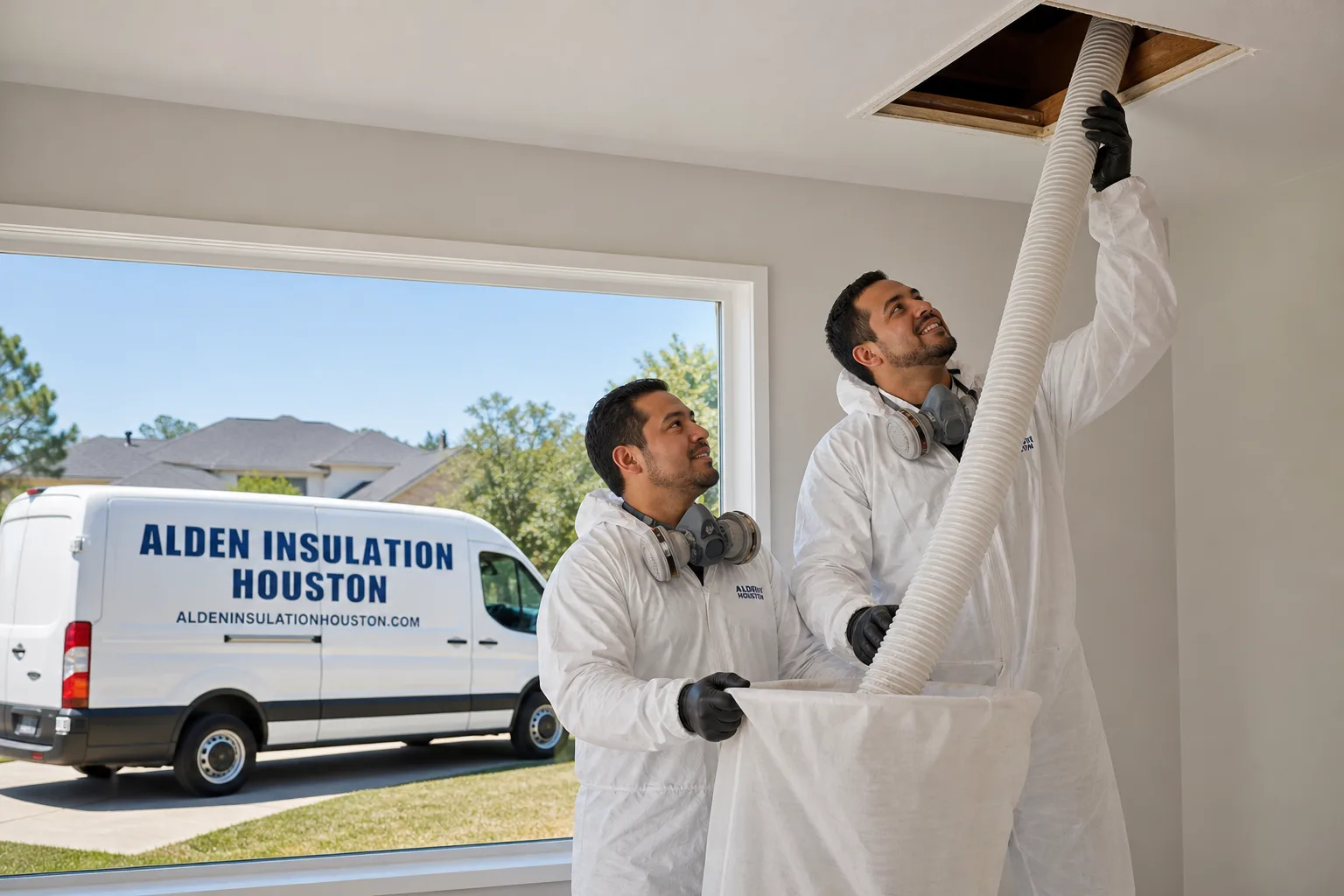
Fast, Reliable Blown In Insulation Across Dickinson
Blown in insulation in Dickinson typically runs $1.45 to $3.50 per square foot installed, and most attics here take one full day. That’s the honest number from a crew that works these streets every week. A properly insulated attic in Dickinson isn’t a luxury. It’s the difference between an August electric bill you shrug at and one that makes you wince.
We know Dickinson’s attics. We know the scuttle holes cut too small for a grown man to fit through. We know the raccoon tracks in the dust, the ductwork sweating in July, and the gray, slumping batts that stopped doing their job ten years ago. When you call Alden Insulation Houston about blown in insulation in Dickinson, you reach a live person who can schedule a background-checked, uniformed technician to your home. Call (806) 581-1010 for a free estimate with a written price before any work begins.
Why Alden Insulation Houston Is Dickinson’s Preferred Blown In Insulation Company
Bryce Holloway runs our crews, and he holds every job to The Garrison Standard: written prices, written guarantees, and technicians who arrive inside the window they promised. We’ve been doing this since 2002 as part of the Garrison Partners family, and Dickinson homeowners call us because they’ve dealt with the alternative. The no-show. The price that changed at the door. The crew that left fiberglass dust across the hallway.
Our Dickinson customers see the same thing every time: a uniformed technician arrives, walks the attic, measures the existing R-value, and writes down a price before a single tool comes off the truck. That price covers the full job. No addendum for “unexpected” vent blockage. No surprise. The 365-Day Done Right Promise backs every installation in writing. If the insulation fails within a year, we return and fix it at no charge.
We dispatch from our Houston office, but the crews serving Dickinson live and work in the Bay Area. They know Hughes Road, Deats Road, and the subdivisions off FM 517. They know what a Dickinson attic smells like in August.
Blown In Cellulose Insulation in Dickinson
Blown In Cellulose Insulation in Dickinson is a dense-packed or loose-fill application of recycled paper fiber treated with borate, and it’s a strong choice for the older tract homes and pier-and-beam cottages that dominate this city. The material settles into odd cavities around attic framing, can lights, and scuttle-hole edges far better than batts ever could. In Dickinson’s 1970s – 1990s housing stock, where joist spacing is rarely uniform and roof pitches get shallow near the eaves, that matters. The borate treatment also discourages the roaches and rodents that find their way into attic spaces along the bayou.
Cellulose costs $1.45 to $2.50 per square foot installed in Dickinson, depending on depth and whether old insulation comes out first. Target R-38 to R-49 here, which means 10 to 12 inches of settled fiber. R-38 is the baseline for our climate zone. R-49 makes a real dent in August cooling costs.
Moisture Management in Bayou Air
Cellulose holds moisture longer than fiberglass, which is the first objection we hear from Dickinson homeowners who understand what 90% humidity does. The answer is not to skip cellulose. The answer is air sealing before blowing. We seal soffit gaps, top plates, and wire penetrations so the air moving through your attic is dry and controlled. Done that way, cellulose performs well here. Done without sealing, it becomes a wet mat after one Gulf storm season.
Cellulose Removal in Dickinson
We also remove old cellulose that has compacted, molded, or been soaked by a roof leak. Dickinson’s wind-driven rain finds every soffit gap, and once cellulose gets saturated, it settles and loses R-value fast. We remove it with high-powered vacuums, haul the debris off, and start clean.
Blown In Fiberglass Insulation in Dickinson
Blown In Fiberglass Insulation in Dickinson uses loose fiberglass fibers, often Owens Corning AttiCat or Johns Manville Climate Pro, blown to a specified depth over the attic floor. It’s the material we recommend most often for Dickinson’s older tract homes because it does not absorb moisture the way cellulose can, and it will not settle as dramatically if a soffit gap gets missed during sealing. For homes near Dickinson Bayou or Clear Creek where attic humidity runs consistently high, that moisture resistance is worth the modest premium.
Fiberglass blown-in runs $1.75 to $3.50 per square foot installed in Dickinson. The spread is driven by attic accessibility, whether old insulation must be removed, and whether we’re adding baffles and sealing in the same visit.
Storm-Season Performance
During a tropical storm, wind-driven rain gets forced into soffit vents and around roof flashing. If fiberglass gets wet, it dries and retains much of its R-value. Cellulose mats down and stays matted. For homeowners in Dickinson who’ve watched a hurricane come across the bay, that distinction is not academic.
Our Field Test on Hughes Road
Our crew was called to a 1980s tract home near Hughes Road where the attic had original R-19 batts that were gray, flattened, and reeked of mildew. After removing the old fiberglass and rodent nests, we air-sealed soffit gaps with foam and blew Owens Corning AttiCat fiberglass to R-38, plus added baffles to keep the new insulation from blocking the soffit vents. The homeowner’s July electric bill dropped by over 20% and our follow-up moisture check showed no condensation on the ductwork.
Trusted Brands We Service in Dickinson
We install and remove insulation from brands homeowners can research on their own before saying yes. For Dickinson attics, we commonly work with Rockwool, CertainTeed, and Demilec. Rockwool’s stone wool resists moisture and does not support mold growth, which matters in bayou humidity. CertainTeed’s fiberglass offers consistent R-value per inch. Demilec’s closed-cell spray foam gives the strongest air seal for pier-and-beam cottages where floor insulation is a concern. We stock common replacement baffles, vent chutes, and sealing products for Dickinson jobs, so the work doesn’t stall waiting on a supply house in Webster or Friendswood. Our Blown In Insulation team can walk you through which material fits your attic and budget.
Common Blown In Insulation Problems We See in Dickinson Homes
- Moldy, settled fiberglass batts from the 1980s. Original R-19 batts in Dickinson tract homes have spent forty years absorbing bayou humidity, rat urine, and roof leaks. They look gray, smell like mildew, and test far below their labeled R-value. Removal comes first.
- Wind-driven rain through unsealed soffits. A tropical storm pushes water sideways into soffit gaps, soaking blown-in fiberglass so it settles and loses R-value. We seal the soffits before blowing, every time.
- Condensation on ductwork and AC pans. When the attic hits 100°F and humidity is at 90%, cold ducts sweat. Blown-in insulation over the ductwork, plus proper attic ventilation, stops the rust and the ceiling stains that follow.
- Bare spots from foot traffic. HVAC techs, cable installers, and pest-control crews trample old insulation flat. You end up with a living-room ceiling that radiates heat. Blowing fresh insulation to R-38 or R-49 eliminates the hot spots.
Pricing for Blown In Insulation in Dickinson, TX
A typical blown in insulation job in Dickinson runs $1,800 to $3,400 for a standard 1,200 to 1,800 square foot attic. Cellulose sits at the lower end, $1,800 to $2,600. Fiberglass lands between $2,000 and $3,400, including removal of old batts when needed. Smaller attics in older homes off Deats Road can run under $1,500. Larger two-story homes near the bayou run higher. The variables are square footage, existing R-value, attic access, and whether old insulation gets hauled out. Every Dickinson estimate includes the written price before work starts and the 365-Day Done Right Promise. Call (806) 581-1010 for a free estimate, and the number you approve is the number on the invoice.
We Also Serve Cities Near Dickinson
Our crews work across the Bay Area. If you’re in Webster, Friendswood, Pearland, or South Houston, we provide the same blown in insulation service with the same written guarantees. Many of our Dickinson customers have family in these neighboring cities, and we’re happy to extend the same pricing discipline and 365-Day Done Right Promise. See our Blown In Insulation in Dickinson page for local details, or call us directly to schedule.
Serving Dickinson, TX - Our Local Coverage Area
We’re based in the Dickinson area and know this community well. Use the map below to see our service coverage - if you’re nearby, we can almost certainly help.
FAQs About Blown In Insulation in Dickinson
It holds up only if the soffits and gaps are sealed before blowing. Wind-driven rain enters through unsealed soffit gaps and soaks the insulation, causing it to settle and lose R-value. We air-seal every Dickinson attic before installing blown-in fiberglass or cellulose, and we recommend fiberglass for storm-prone areas because it dries and retains R-value better than cellulose.
Yes. In most 1980s Dickinson tract homes, the original R-19 batts are compacted, rodent-damaged, and mold-laden, and leaving them under new blown-in insulation creates a damp layer that continues to harbor mold and block proper air flow. Removal adds to the cost but it’s the correct job. Call (806) 581-1010 for an exact quote on removal and re-insulation.
It can if the attic is not air-sealed. Cellulose holds moisture longer than fiberglass, and in Dickinson’s 90% ambient humidity, trapped moisture inside cellulose leads to mold growth on the roof sheathing and settled material. We only install cellulose in attics where we have first sealed the soffits, top plates, and penetrations.
The baseline for Dickinson’s climate zone is R-38, which means 10 to 12 inches of settled blown-in fiberglass or cellulose. We often recommend R-49 for homeowners who want a significant reduction in July and August cooling costs, especially on older tract homes with original R-19 batts.
It reduces the temperature difference between the attic air and your ductwork. Dickinson pier-and-beam cottages often have ducts running through unconditioned attic space, and when the attic hits 100°F with 90% humidity, cold ducts sweat. Blowing insulation to R-38 or R-49 over the ducts stops the condensation that rusts AC pans and stains ceilings.
Written by Bryce Holloway, Owner at Alden Insulation Houston, serving Dickinson and the Bay Area since 2002.