
How Much Does Insulation Cost in Houston?
Most attic insulation projects in Houston run between $1,650 and $4,900, with the average homeowner spending right around $2,800 for blown-in fiberglass or cellulose across a 1,500-square-foot attic. Larger homes, spray foam applications, and projects that require old insulation removal push costs higher, while straightforward top-offs on newer attics land on the lower end.
The single biggest pricing variable is the type of material you choose. Blown-in fiberglass runs $1.10 to $2.20 per square foot installed. Blown-in cellulose costs $0.90 to $1.80 per square foot. Open-cell spray foam lands between $1.80 and $3.20 per square foot, and closed-cell spray foam, which delivers a higher R-value per inch and doubles as a moisture barrier, runs $2.90 to $5.40 per square foot. We install all four and will give you a written price before any work starts, so the number you approve is the number on the invoice.
Insulation Cost Breakdown (2026)
| Project Type | Typical Cost Range (Houston) | What It Includes |
|---|---|---|
| Attic blow-in top-off (existing insulation) | $950 – $1,900 | Adding blown-in fiberglass or cellulose over existing material to reach R-38 or R-49 |
| Full attic insulation (new or gutted) | $1,800 – $3,800 | Complete blown-in application for a 1,200 to 2,000 sq ft attic |
| Insulation removal and replacement | $2,800 – $5,800 | Vacuuming out old or contaminated insulation, then installing new material |
| Open-cell spray foam (new application) | $3,200 – $7,200 | Spray-applied foam for attic roof decks or walls, typically R-21 to R-38 |
| Closed-cell spray foam (new application) | $5,000 – $12,500 | High-density foam with the highest R-value per inch; acts as air and moisture barrier |
| Air sealing plus insulation | $2,300 – $5,400 | Sealing penetrations around plumbing, electrical, and ductwork before insulating |
These ranges reflect what Houston homeowners actually pay in 2026, not national averages that don’t account for our heat and humidity. The city’s climate puts real stress on insulation systems, and the pricing above reflects contractor rates for work done by licensed, insured crews that carry workers’ compensation and stand behind their labor in writing.
What Drives Cost Up or Down
Square footage matters more than anything else. A 1,000-square-foot attic in Timbergrove costs less to insulate than a 3,000-square-foot attic in Memorial, full stop. But the condition of what’s already up there matters nearly as much. If your existing insulation is dry, free of mold, and sitting near the target depth, a top-off is cheap and fast. If it’s water-damaged, rodent-infested, or compressed to the point where it’s lost its R-value, removal becomes the necessary first step, and removal adds labor hours and disposal fees.
Access is another factor a lot of homeowners don’t consider until the quote comes back. Tight attic hatches, pitched roof lines with limited headroom, and HVAC equipment blocking the workspace all slow a crew down. Houston homes built before 1980 often have shallow attic cavities that make maneuvering slower, which shows up in the labor line.
What Affects Insulation Pricing in Houston
- Attic size and geometry. Square footage is the baseline, but a steep hip roof with tight corners takes longer to insulate properly than a simple gable roof. Labor is a real line item, and geometry drives it.
- Houston humidity and moisture history. Our climate means attics run hot and damp seven months of the year. If existing insulation has absorbed moisture, it loses effectiveness and often needs removal. We see this constantly in older homes in Bellaire, Westbury, and the Heights, where ventilation issues let humid air sit against the fiberglass.
- Current R-value. Houston code calls for R-38 in most attics, though R-49 is increasingly common for new construction and energy-conscious retrofits. The difference between topping off from R-19 to R-38 versus R-19 to R-49 is about 25% to 30% more material.
- Material choice. Fiberglass batts, blown-in fiberglass, blown-in cellulose, open-cell foam, and closed-cell foam all carry different price points. Foam costs significantly more per square foot than blown-in products but delivers air-sealing benefits that fiber products don’t.
- Removal requirements. If your attic has old rock wool that’s settled, vermiculite, or insulation contaminated by pests, the old material has to come out first. Removal runs $1.00 to $1.75 per square foot in Houston before new insulation goes in.
- Air sealing scope. Attics with recessed lighting, bathroom fans venting into the attic space, and plumbing chases need more sealing work. Each penetration sealed is time saved on your energy bill, but it’s also labor on the front end.
Labor and Material Costs in the Houston Market
You’ll see labor rates for insulation crews in Houston running between $55 and $95 per hour per worker, with most residential jobs requiring two to three workers for a half-day to a full day. Blown-in fiberglass as a material costs $0.45 to $0.70 per square foot at Houston distributor pricing before labor. Cellulose runs slightly less, which is why it’s often the go-to for budget-conscious homeowners who still want a real performance upgrade.
Spray foam is a different animal. The material itself costs $0.90 to $1.80 per board foot for open-cell and $1.50 to $2.60 per board foot for closed-cell at local prices. The equipment required to apply it, plus the training and safety protocols involved, is why foam installations carry a premium over blown-in products. We install products from eight manufacturers: Owens Corning, Johns Manville, Knauf, Rockwool, CertainTeed, Icynene, Demilec, and GreenFiber. You can look up any of these brands before you commit, and we’ll tell you exactly which product goes into your attic and why.
How to Save on Insulation
The cheapest insulation job in Houston is the one where you only pay for what’s actually needed. Here’s what that looks like in practice.
- Get a written price before work starts. Alden Insulation Houston gives you a written quote with the material, square footage, target R-value, and labor all itemized. No revised number at the door, no surprise line items. You’ll know exactly what you’re paying and what it covers.
- Consider a top-off instead of full replacement. If the insulation in your attic is dry, free of mold, and hasn’t been compressed by years of foot traffic, blowing additional material on top is the most cost-effective path to higher R-value. Full replacement only makes sense when the existing material has failed.
- Bundle air sealing with insulation. If you’re already having a crew in the attic, sealing penetrations at the same time costs less than scheduling it as a separate visit. Air sealing without new insulation is like patching a tire and leaving the slow leak in the valve stem.
- Don’t over-insulate past your climate’s sweet spot. In Houston, R-38 to R-49 is the practical ceiling for most attics. Beyond R-49, you’re paying for diminishing returns. We’ll tell you plainly if adding more material won’t pay for itself.
- Check for utility rebates. CenterPoint Energy and some Houston-area co-ops periodically offer rebates for insulation upgrades, and federal tax credits apply to certain materials. These don’t change our quote, but they can reduce your net cost.
We don’t run discount gimmicks. The price we quote is what the job costs, and our estimates are free. Call (806) 581-1010 and we’ll walk you through what your attic actually needs.
Why Houston Attics Need More Than a Basic Blow-In
Houston’s climate punishes attics. Summer attic temperatures routinely hit 140°F, and the humidity that hangs over the Gulf Coast from May through October means moisture is always finding its way into the attic space. Insulation that would perform fine in Dallas or San Antonio struggles here because it’s fighting two fronts: heat pushing down from the roof deck and moisture pushing up from the living space.
That’s why air sealing matters as much as the insulation itself in a Houston home. A vented attic with fiberglass or cellulose needs a good air barrier between the conditioned space and the attic. Without it, humid indoor air migrates up through light fixtures, plumbing penetrations, and framing gaps, condenses against the roof deck, and soaks into the insulation below. We see this pattern constantly in neighborhoods like Meyerland, Oak Forest, and Spring Branch, where homes from the 1960s and 1970s were built with minimal attention to attic air sealing.
When we install insulation in a Houston attic, we’re not just dumping material and leaving. The Garrison Standard, which is the operating code for every job under the Garrison Partners umbrella, requires that the attic be assessed for moisture, ventilation, and air leakage before any new material goes in. That’s not an upsell. It’s doing the job by the book.
Signs You’re Overpaying for Energy Because of Bad Insulation
Before you call for a quote, it helps to know what failing insulation looks like from inside the house. These are the signs we hear about most often from Houston homeowners.
- Upstairs rooms that run 5 to 10 degrees hotter than downstairs in August. That’s classic attic insulation failure. The heat load from the attic space overwhelms what’s left of the thermal barrier, and the upstairs HVAC system runs nonstop trying to keep up.
- Energy bills that spike every summer despite no change in thermostat settings. Houston electricity rates have gone up, but if your usage is climbing year over year, the attic is usually the culprit.
- Cold spots in winter. Houston winters are mild, but a poorly insulated attic still lets heat escape through the ceiling. If certain rooms never seem to warm up, check the insulation above them.
- Pest activity in the attic. Rats and squirrels love nesting in insulation. Once they’ve moved in, the material is contaminated and usually needs removal and replacement, not just a top-off.
- Visible mold or mildew on the underside of the roof deck. This signals a ventilation problem, and it’s almost always accompanied by insulation that’s absorbed moisture and lost its R-value.
If any of these sound familiar, the fix usually starts with an attic inspection. Call (806) 581-1010 and we’ll come out, take a look, and tell you honestly whether you need new insulation or whether what you have can be salvaged.
Houston Building Code and Insulation Requirements
The City of Houston enforces the 2015 International Energy Conservation Code with local amendments, which requires R-38 ceiling insulation for most residential attics. Some newer developments in Fort Bend County, Montgomery County, and the Energy Corridor area enforce the 2018 or 2021 IECC, which raises the ceiling requirement to R-49. That’s a meaningful difference in material volume, and it’s one of the reasons why quotes for the same square footage can vary between a home in Sharpstown and a new build in Katy.
When we quote a job, we check the current code requirements for your specific address and pull permits where required. We don’t skip this step. A permit with an inspection protects you as the homeowner, and it’s part of operating under The Garrison Code, which is our internal operating standard: written prices, written guarantees, background-checked crews, and work done to code the first time.
Insulation Removal in Houston: What It Costs and When You Need It
Removal is the line item that catches Houston homeowners off guard, so let’s talk about it plainly. If your existing insulation has been soaked by a roof leak, infested by rodents, contaminated by a raccoon or opossum that got into the attic, or compressed by decades of settling, adding new material on top of it doesn’t fix the problem. The old material has to come out first.
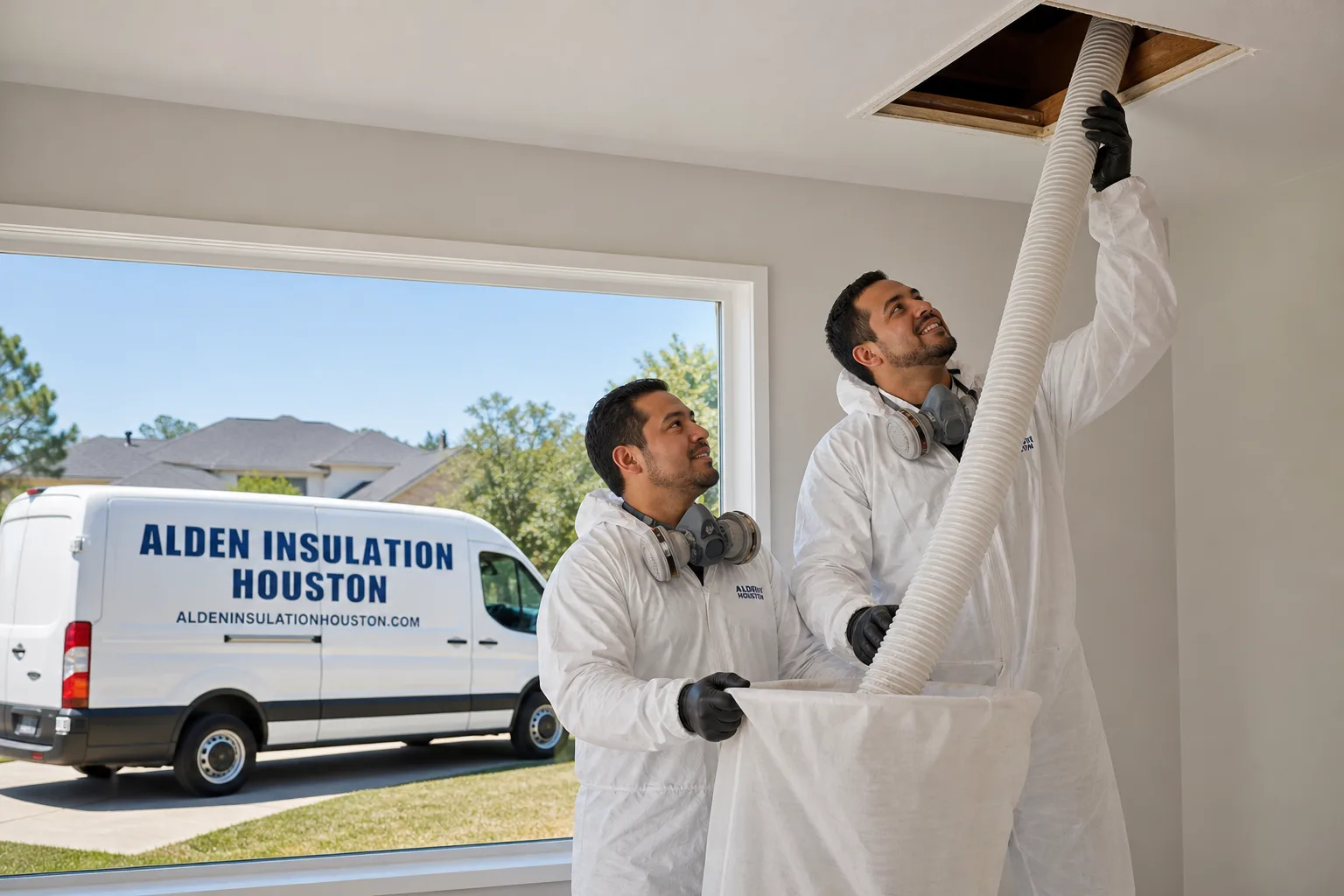
In Houston, insulation removal runs $1.00 to $1.75 per square foot depending on the depth of the material, the accessibility of the attic, and whether the insulation is loose-fill or batt. A 1,500-square-foot attic typically costs $1,500 to $2,600 for removal alone, before new insulation goes in. We use commercial vacuum systems that pull the old material out through a hose while the crew works in full protective equipment, and we bag and haul everything off your property. You won’t be stuck with a pile of old insulation on the curb.
After removal, we’ll typically find things worth addressing before new material goes in: old knob-and-tube wiring that should be flagged for an electrician, recessed light housings that aren’t IC-rated and need protective covers, bathroom exhaust fans venting into the attic instead of through the roof. Fixing these before the new insulation goes in is cheaper than fixing them after, and it’s part of doing the job right.
How the Installation Process Works at Alden Insulation Houston
Here’s what happens when you call us for attic insulation in Houston.
- You call (806) 581-1010. A live person answers, 24/7. Not a voicemail, not an answering service that takes a message, a human being in our office.
- We schedule a visit inside a specific window. Our technicians are uniformed and background-checked, and they arrive inside the window we promised. Not a vague “sometime between 9 and 5.”
- We assess your attic. We measure square footage, check the current R-value, look for moisture and ventilation issues, and identify air leaks. We’ll tell you exactly what we find.
- You get a written price. Before any work starts, you have the number in your hand, itemized by material and labor. That number is the number on the invoice. Period.
- We do the work. Our crew installs to the target R-value, using products from Owens Corning, Johns Manville, Knauf, Rockwool, CertainTeed, Icynene, Demilec, or GreenFiber. We leave the attic and the rest of your home clean.
- You get a written guarantee. Every job is covered by the 365-Day Done Right Promise. If the work fails within that year, we come back and make it right at no charge. That guarantee is in writing, and it’s non-negotiable.
Bryce Holloway leads our Houston operation, and he’s the person who signs off on the guarantee for your job. The Garrison Standard has been in place since 2002, and it applies to every job we do, no exceptions.
Comparing Insulation Materials: Which One Makes Sense in Houston?
Houston’s climate makes this conversation different than it would be in Minneapolis or Chicago. Here’s how the materials compare in our specific market.
Blown-in Fiberglass
Cost: $1.10 to $2.20 per square foot installed. R-value of R-2.2 to R-2.7 per inch. Blown-in fiberglass is the most common insulation in Houston attics, and for good reason: it’s affordable, it installs fast, and it performs well in vented attics where air sealing has been done properly. Fiberglass doesn’t absorb moisture the way cellulose does, which is a real advantage in our humidity. We install Owens Corning, Johns Manville, and Knauf blown-in fiberglass products.
Blown-in Cellulose
Cost: $0.90 to $1.80 per square foot installed. R-value of R-3.2 to R-3.8 per inch, which is higher per inch than fiberglass. Cellulose is made from recycled paper treated with borate for fire and pest resistance, and it’s the most popular budget-friendly option in Houston. The trade-off: cellulose absorbs moisture more readily than fiberglass, which matters in a climate where attic humidity is a constant battle. We install GreenFiber cellulose, and we’ll be honest with you about whether it’s the right fit for your attic’s conditions.
Open-Cell Spray Foam
Cost: $1.80 to $3.20 per square foot installed. R-value of R-3.5 to R-3.8 per inch. Open-cell foam is sprayed directly onto the roof deck to create a conditioned attic space, and it doubles as an air barrier. For Houston homes with ductwork in the attic, which is most of them, a conditioned attic can cut cooling costs meaningfully because your ducts aren’t sitting in 140°F air. We install Icynene and Demilec open-cell products.
Closed-Cell Spray Foam
Cost: $2.90 to $5.40 per square foot installed. R-value of R-6.0 to R-7.0 per inch, the highest of any option. Closed-cell foam is a vapor barrier as well as an air barrier, which makes it the top choice for Houston homes with persistent moisture problems. It’s the most expensive option by a wide margin, but for the right house, it pays for itself in cooling savings and moisture protection. We install Demilec and Icynene closed-cell products.
Houston Neighborhoods We Serve
Alden Insulation Houston works across the metro, and we know the housing stock neighborhood by neighborhood. A 1950s ranch in Meyerland has different insulation needs than a 1990s two-story in Cypress or a brand-new build in Pearland.
- Inner Loop neighborhoods (Heights, Montrose, Timbergrove, Garden Oaks): Older homes with limited attic access, original insulation that’s often settled or absent, and tight lots that make equipment staging tricky. We do a lot of removal and replacement work here.
- West Houston (Energy Corridor, Memorial, Katy, Sugar Land): Larger attics, higher ceilings, and homes from the 1980s through 2010s. Full attic retrofits and foam jobs are common.
- North and Northwest (Spring, Cypress, Tomball, The Woodlands): Fast-growing suburbs with a mix of older country homes and new construction. Code requirements vary by county, and we check what applies for your address.
- Southeast (Pearland, Friendswood, Clear Lake, League City): High humidity near the bay means moisture management is critical. Air sealing before insulation is standard practice here.
- Northeast (Humble, Kingwood, Atascocita): Homes with large attic spaces and heavy tree cover, which affects ventilation and moisture. We see more mold-related insulation failures in these areas than anywhere else in the metro.
If you’re not sure whether we cover your neighborhood, call. We’ll tell you straight, and if we can’t help, we’ll point you in the right direction.
FAQs – Insulation Cost
How much does it cost to insulate a 1,500 square foot attic in Houston?
A 1,500-square-foot attic in Houston costs $1,650 to $3,600 to insulate with blown-in fiberglass or cellulose, depending on the current R-value and whether any removal or air sealing is needed. If you’re starting from bare framing, the higher end applies. Call (806) 581-1010 for an exact quote, estimates are free.
Is it cheaper to insulate my attic myself?
Raw blown-in fiberglass costs about $0.45 to $0.70 per square foot at Houston home centers, so a DIY job on a 1,500-square-foot attic runs $700 to $1,100 in materials, less than half the installed cost. But you’re renting the blowing machine, hauling the bales into the attic, working in 130°F heat, and guessing on depth unless you own a ruler and the patience to check R-value every five feet. Most homeowners who start this job call us before it’s done. For a written price on professional installation, call (806) 581-1010.
How much does spray foam insulation cost in Houston?
Open-cell spray foam runs $1.80 to $3.20 per square foot installed in Houston, and closed-cell spray foam runs $2.90 to $5.40 per square foot. For a typical 1,800-square-foot attic, that’s roughly $3,200 to $7,200 for open-cell and $5,200 to $9,700 for closed-cell. Foam costs significantly more than blown-in products but delivers air-sealing and moisture-control benefits that fiber products don’t. We’d be glad to give you a written quote for either option. Call (806) 581-1010.
What does it cost to remove old insulation in Houston?
Insulation removal in Houston runs $1.00 to $1.75 per square foot, so a 1,500-square-foot attic costs $1,500 to $2,600 for removal before new insulation goes in. You need removal if the existing insulation is water-damaged, moldy, rodent-infested, or compressed beyond usefulness. After removal, we install fresh material to current Houston code. For a combined removal and replacement quote, call (806) 581-1010.
Does insurance cover insulation replacement in Houston?
Homeowners insurance generally covers insulation replacement when the damage was caused by a covered peril, like a roof leak from a hailstorm or a burst pipe. It typically does not cover insulation that’s deteriorated from age, humidity, or pest damage. If you’re filing a claim, we can document the existing condition of your attic insulation to help. Call (806) 581-1010 and we’ll walk you through what we typically see with Houston-area claims.
How long does insulation last in a Houston attic?
Blown-in fiberglass and cellulose last 20 to 30 years in a Houston attic if the roof doesn’t leak and the attic stays dry, but our humidity shortens that lifespan when ventilation is poor. Spray foam can last 50 years or more if applied correctly. If your insulation is more than 20 years old, compressed, or showing signs of moisture, it’s worth having it assessed. Call (806) 581-1010 for a free attic inspection.
Why Homeowners in Houston Choose Alden Insulation
There are plenty of insulation contractors in Houston who will give you a low number over the phone and revise it once they’re standing in your driveway. That’s not how we operate. Alden Insulation Houston is part of the Garrison Partners family, which has been held to The Garrison Standard since 2002. The Standard means a written price before any work starts, a written guarantee on every job, and a background-checked, uniformed crew that shows up inside the window we promised.
Our 365-Day Done Right Promise covers every installation and removal we do. If the work fails within a year, we return and fix it at no charge. That’s not a marketing line; it’s the written guarantee you’ll get before we start. Bryce Holloway runs our Houston operation, and the standard he enforces is the same standard Garrison Partners has held for every job since 2002.
When you’re ready to talk about your attic, call (806) 581-1010. A live person answers, 24/7. We’ll set a time, send a technician in uniform, and give you a written price. No pressure, no games, no revised numbers at the door.
Key Takeaways
- Houston attic insulation costs $1,650 to $4,900 for most homes, with the average around $2,800 for blown-in fiberglass or cellulose on a 1,500-square-foot attic.
- Blown-in fiberglass runs $1.10 to $2.20 per square foot installed. Spray foam costs $1.80 to $5.40 per square foot depending on open-cell or closed-cell.
- Removal adds $1.00 to $1.75 per square foot when old insulation is damaged, moldy, or contaminated.
- Houston code requires R-38 in most attics, with some newer suburban developments enforcing R-49.
- Alden Insulation Houston provides written prices and a 365-day written guarantee on every job, with a free repair visit if the work fails within that year.
- Free estimates: call (806) 581-1010 and a live person answers, day or night.
Pricing reflects the Houston market as of 2026. Alden Insulation Houston offers free estimates – call (806) 581-1010.
Written by Bryce Holloway, Owner at Alden Insulation Houston, serving Houston since 2002.
What Our Customers Say
"Removed rodent-damaged insulation, sanitized, and replaced it. Thorough and honest."
- Sue M."Spray foam in the rim joist. Floors above are warmer."
- Iris L."Blown-in insulation in the attic by a veteran crew. They air sealed the top plates first, installed baffles, and marked the depth with rulers. Bills dropped right away."
- Roy H.